Review of the winning films of the Antares Film Festival-2026
01.10.2026
Cinema that returns us to ourselves.
Andrey Afrin, festival director and program director of the film festival:
- I thought for a long time about where to begin this final review. Probably with a question. Here's which one: when was the last time you saw a film where the main character is not a superhero, not a billionaire, not an investigator with a tragic past, but just a person doing their job? A cleaner. A hairdresser. A gas station attendant. A social worker who goes around to pensioners' apartments, measures blood pressure, buys medicine, listens. Just listens. Can you recall such a film? I — (outside the Antares festival program) with difficulty. And that is precisely why the Antares Film Festival, which has been held in Russia for the third year in a row, seems to me an event not so much cultural as anthropological. Because it does what big cinema has long abandoned: it looks at the working person not from above and not from the side, but directly. Without pity, without admiration, without ideological lining. It just looks.
This year there were 172 films from 44 countries in the competition. The theme is the diversity of professions. And do you know what I realized when I received the list of winners from the Jury Secretary Irina Petrova? That the jury was not choosing films about professions. It was choosing films about how a person understands themselves through a profession. Or doesn't understand. Or understands too late. This is a fundamentally different optics. Because a profession is not what we do. It is what we pay for the right to call ourselves human. And the festival feels this.
.
Grand Prix, or the Story of One Loss
The Grand Prix went to the Argentine film "The Star I Lost". Director — Luz Orlando Brennan. The story, if retold in two words, is almost banal: an aging actress, 76 years old, rehearses a play where she plays a woman with Alzheimer's disease. The daughter is about to leave. That's it. No chases, no explosions. But this is a film about how a profession becomes a person's last refuge when everything else — body, memory, loved ones — goes away. Norma Reyes continues to rehearse not because she needs the role. But because the role is the only place where she still exists. Acting here is not pretense but a form of resistance to disintegration. And when I understood this, I felt uneasy. Because I thought: what will remain of me when everything else goes? My profession? And is it enough to stay on the surface?
The chair of the feature film competition this year was film director Natalia Uglitskikh. Together with 10 jury members from 4 countries, they collectively named the film "Steppe Gods" by Oleg Asadulin as the best feature film. Transbaikalia, summer of 1945. A boy saves a friend by turning for help to a captured Japanese doctor. This is an adaptation of Gerasimov, and it has that piercing simplicity that distinguished the best Soviet films about war — not parade ones, but human ones. The doctor here is not a profession but a bridge. Between cultures, between life and death, between the boy and the adult world that is collapsing and reassembling. I watched this film and thought that mercy is also a profession. Maybe the main one.
And here, in the key of this trajectory of our conversation, I want to say a few words about the film that received the award "For Best Screen Adaptation of a Profession" in the Feature Film Competition. This is the film - "In the Heavens" by Uzbek director Jakhongir Kasymov — a man whose name in Central Asia means roughly the same as the name German means for Russian cinema. The film tells about a young pilot Badalov, who after the collapse of the USSR finds himself needed by no one, returns to Tashkent, and meets a legendary pilot nicknamed Graf. This is a story about a mentor and a student, about professional honor that is higher than fear and higher than power. And do you know what caught me in it? That the sky here is not a metaphor. It is a place where a person remains one-on-one with himself, where there is no nationality, no position, no past. There is only you and your responsibility. Graf refuses to take off when he sees his former superior in handcuffs, and this refusal is not a gesture but an act that costs a career and, perhaps, life. Kasymov makes a film about how the profession of a pilot is not a job but a way of existing in a world where everything is bought and sold, but there is still something that is not for sale. I watched this film and thought: here it is, a true screen adaptation of a profession. Not about how a person flies a plane, but about how a plane leads a person to himself.
.
People We Don't See
In the short film competition, a strange thing happened: the prize for best film was not awarded. To no one. I don't know the reasons, but this decision seems honest to me. The chair of the competition jury, film director Mark Gorobets, decided so. He had the right. Because choosing one short film out of dozens of worthy ones is always violence. Or maybe the jury simply was not united enough on one film to call it the best. Didn't want to. It happens.
However, the prize for best screen adaptation of a profession went to the Iranian film "Nabi" — about an Afghan cleaner who worked in Iran for 25 years and then was fired. He must work his last day and leave. Like a person who never existed. This, I believe, is one of the strongest metaphors I have seen in recent years. Because it is not about Iran or Afghanistan. It is about all of us. About how the labor of millions remains invisible. About how a person can wash floors for 25 years and then disappear — and no one will notice. And when I write this, I think: will they notice me? Will they notice you? Or are we all potential Nabies, we just don't know it yet?
And there was also the film "Fondue" — animated, six minutes, directed by Kristina Kesler. A girl with excess weight comes to her first ballet lesson. She cannot do the movements like everyone else. She bumps into others, outweighs the bench, blocks the mirror. But when the coach says "Fondue!", she freezes — and plunges into memories of the cheese delicacy. It is funny and sad at the same time. And this is also about labor — about how a body that does not fit professional standards still has the right to its place in the world. By the way, the jury of the Animated Film Competition was headed by Anna Karpova, production designer of animated cinema. This is important.
.
Profession as a Form of Memory
Best documentary film — "Razlogov" by Anastasia Razlogova. Let me remind you that the chair of the documentary film competition jury was Vladimir Karachevsky — film producer and director from Belarus. The film "Razlogov" is a portrait of film scholar Kirill Razlogov, with his last interview, archival materials, animation. Many knew Kirill Emilievich personally, and for me this film is not just a biography. It is a reflection on how a profession becomes a way to preserve culture. A film scholar is not one who watches films. It is one who remembers them. And passes the memory on. And when I watched this film, I thought that every profession has this function — memory. A doctor remembers the illnesses he treated. A teacher remembers students. A cleaner remembers where things are. We are all keepers of something. And this may be the most important thing in labor.
"All Beauty in a Straight Line" by Irina Vasilyeva is a documentary film about the village of Verkola, the birthplace of Fyodor Abramov. The writer's nephew Vladimir and his wife Asya receive guests, preserving the spirit of northern simplicity. This is a film about how labor becomes a form of love for a place that is almost gone. And about how preservation is also a profession. Maybe the most ancient.
And "Depth — A Game Not by the Rules" by Pavel Karchevsky is about an operator-researcher who studies beluga whales in Solovki. He tries to understand the logic of their interaction with people, but the usual rules of observation do not work. This is a film about the boundaries of the scientific method. And about how dialogue is possible only on nature's terms — not ours. The researcher's labor here is not conquest but attention. Just attention. And this is probably the most honest form of labor I can imagine.
.
What It All Means
I will not pretend to know the answer to the question of what trends define the face of Antares-2026. Trends are what critics see when they need to write a report. I see something else. I see that the festival jury among the laureates chose vulnerability. Not weakness, but precisely vulnerability — the state in which a person is open to the world because they have no armor. A cleaner who is being fired. An actress who is losing her memory. A hairdresser insulted by a client. A gas station attendant who cannot escape the monotony. They are all vulnerable. And they are all winners. Because vulnerability is not something to overcome. It is something to acknowledge. And then it becomes strength.
Someone may object: it's a festival, there should be celebration, gloss, red carpet. Yes, all that was there. But the essence is not in that. The essence is that Antares does what big cinema has stopped doing — it returns us to ourselves. Our right to be unheroic. Our right to labor that no one notices. Our right to fatigue, to doubt, to a small life. And if this is not ideology, then I don't know what ideology is.
I will end like this. Once Andrey Platonov wrote: "Without me the people are incomplete." This, in my opinion, is the main idea of Antares. Every person is necessary. Every profession is irreplaceable. And every film that tells about this makes us a little more full of meaning. Even if we don't notice it. Even if we just watch cinema.
Other news
09.10.2026 г.
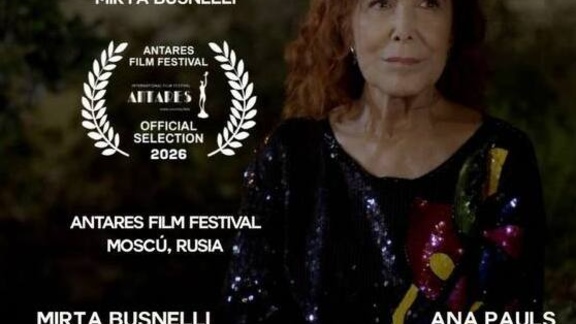
The Argentine film portal CinePosta reported on the triumph of an Argentine film in Moscow.
The Argentine film portal CinePosta has reported on the triumph of the film *Luz Orlando Brennan* at the 3rd Antares International Film Festival in Moscow
30.09.2026 г.
The voice that was heard: Undelivered — the best scenario about the profession
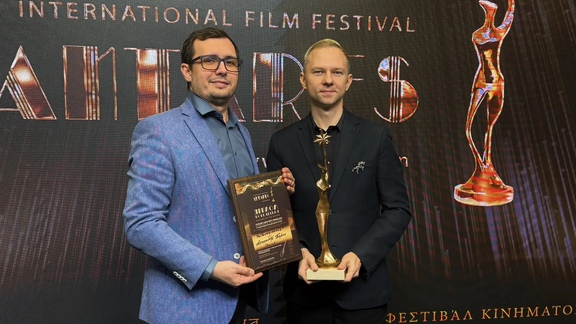
The award ceremony for the winner of the Screenwriting competition took place at the office of the Antares International Film Festival. The award was presented by the director of the film festival Andrey Afrin.
28.09.2026 г.
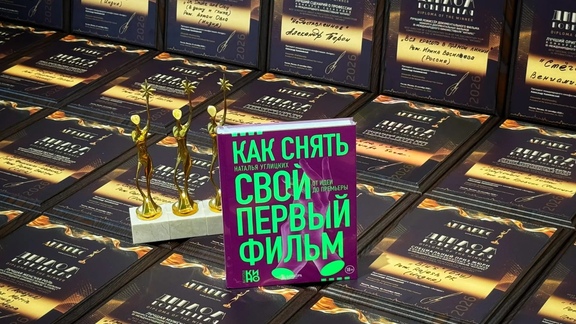
The book from the Bombora publishing house will be sent from Moscow to 11 countries of the world
The III International Film Festival “Antares” has ended in Moscow. This year t
Мы используем файлы cookie для обеспечения правильной работы нашего веб-сайта, чтобы сделать еще лучше нашу коммуникацию! Оставаясь на нашем сайте, вы автоматически соглашаетесь с использованием файлов cookie и принимаете пользовательское соглашение.


 09.10.2026 г.