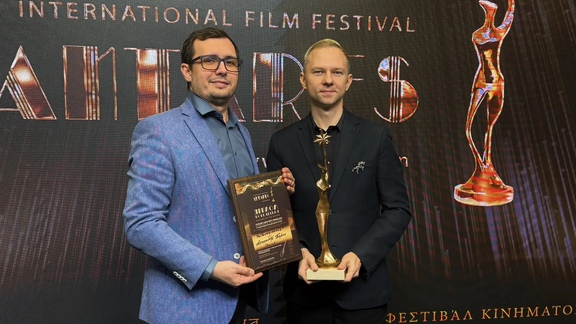
Analytical Review of the Competition Program of the III IFF “Antares”
The III International Film Festival “Antares”, dedicated to the Working Person and diversity, represents a unique cross‑section of contemporary cinema. Unlike most festivals, where a hero's profession often serves merely as a backdrop for drama, here profession becomes the main character — a prism through which destinies, history, and the meaning of existence are refracted. Bringing together 172 films from 44 countries and featuring more than 130 professions, the festival program turns into a vast encyclopedia of human activity, but more importantly, into a profound philosophical statement about the place of man in the world.
Profession as a foothold: between calling and survival
The unifying motif of most works is the existential choice: is work a curse, a routine, or a lifeline that gives meaning? The filmmakers move away from heroic pathos. Instead, they show labour as a complex, often painful dialogue between a person and themselves and their circumstances.
In fiction films, this theme unfolds through identity crises. We see an accountant whose “invisibility” becomes a superpower, and a courier whose lies about himself turn into a tragicomic investigation. Particularly indicative is a body of films about “risky” and lonely professions: polar pilots, sea captains, psychiatrists. Here, labour becomes not just work, but a test of the strength of the human spirit. The heroes balance on the edge of life and death (like the aircraft commander who saves passengers at the cost of his own life), and that edge reveals the true essence of a person — their honour, their memory, their pain.
A vanishing world: the memory of craft and the silence of workshops
One of the strongest and most poignant themes of the festival is disappearance. In the documentary and animation sections, the audience will encounter a world that is disappearing before our eyes. The festival captures this with almost ethnographic meticulousness.
The central conflict here is the clash between living human craftsmanship and soulless machines or globalisation. Directors present us with umbrella makers from Croatia, blacksmiths from Pakistan, potters from India, tea growers from China, and a legendary animation artist. These films share a common anxiety: what will remain after us when the craft dies? But instead of nostalgia, the authors offer a dialogue. In one film, a robot cynically proves human inefficiency, but the camera shows the warmth, the “soul” that turner Danila puts into metal, or the connection to the land that an old fisherman preserves. The festival asserts: it is not the profession that disappears, but the ability to feel material and time. In this context, “Antares” acts as an archivist of the human soul.
Social optics: invisible people and the weight of care
A separate powerful block consists of films that change the optics of perception. They show the “invisible” people of our society — those who carry it on their shoulders. These are garbage collectors from Indonesia, social workers caring for lonely elderly people, sappers clearing minefields, and search teams returning names to fallen soldiers.
What unites these films is the motif of sacrifice. The heroes do not perform feats in the usual sense; their feat lies in daily service. Films about doctors, nurses, and caregivers (from Italy to Argentina) show labour as an intimate act of human participation, where the line between profession and personal life blurs. Works raising gender issues deserve special attention: a female welder, female construction workers in India losing their jobs due to automation, and the first woman captain of an icebreaker. These films speak not just about labour, but about the right to be who you want to be, regardless of stereotypes.
Metaphysics of labour: cosmos and culture
Some films in the program rise to a cosmic, metaphysical level. These are films about cosmonauts, deep‑sea researchers (a beluga research operator), archaeologists, and even priests and clergy.
Here, profession becomes a tool for understanding the universe. The heroes of these films seek answers to questions about existence, life, and death. For example, the story of a psychiatrist grows into a shared delirium about the end of the world, while the investigation into the life of Faizulla Khodjaev in Uzbekistan shows how the profession of politician and fighter becomes a tragedy against the backdrop of history. These works are united by a sense of the mystery of the world (“The Hills”) and an attempt to capture the intangible — whether it is the smell of old coffee from a Moroccan barista or the ring of steel in a forge.
Emotional contrast: from black humour to quiet joy
For all the seriousness of the themes, the program is not without lightness. A comedic noir about an Italian caregiver or stories about a New Year’s courier add colour. However, even in comedy, a deep thought shines through: labour is what connects generations. The screenplay competition and animated films (for example, about a girl ecologist) look to the future, asking the question: “What will we leave behind?”
The III IFF “Antares” is not a career‑guidance film festival. It is a portrait of humanity, drawn through its occupations. The audience will see not just a montage of working days, but a kaleidoscope of destinies, where through a machine, a brush, a scalpel, or a steering wheel, the heroes speak about love, loneliness, memory, and death.
The unifying theme of all the films is the search for authenticity. In a world where technology devalues manual labour and crises erase boundaries, a person remains human thanks to their work. And “Antares” proves: profession is not a line in a work record book, but a way to resist chaos, preserve dignity, and pass the baton of life further. This is the main drama and the main hope of the 2026 program.


 09.10.2026 г.